Base64 is one of the most widely used encoding methods in modern software development. Developers use it to safely transfer data, store binary content as text, and exchange information between systems.
Although Base64 may look complicated at first glance, the concept is actually quite simple.
In this guide, you'll learn what Base64 is, how it works, where it is used, and why it remains an essential tool for developers.
What Is Base64?
Base64 is an encoding scheme that converts binary data into plain text.
Computers store files, images, videos, and documents as binary data consisting of 0s and 1s. However, some systems are designed to work only with text.
Base64 solves this problem by converting binary data into a text format that can be transmitted safely.
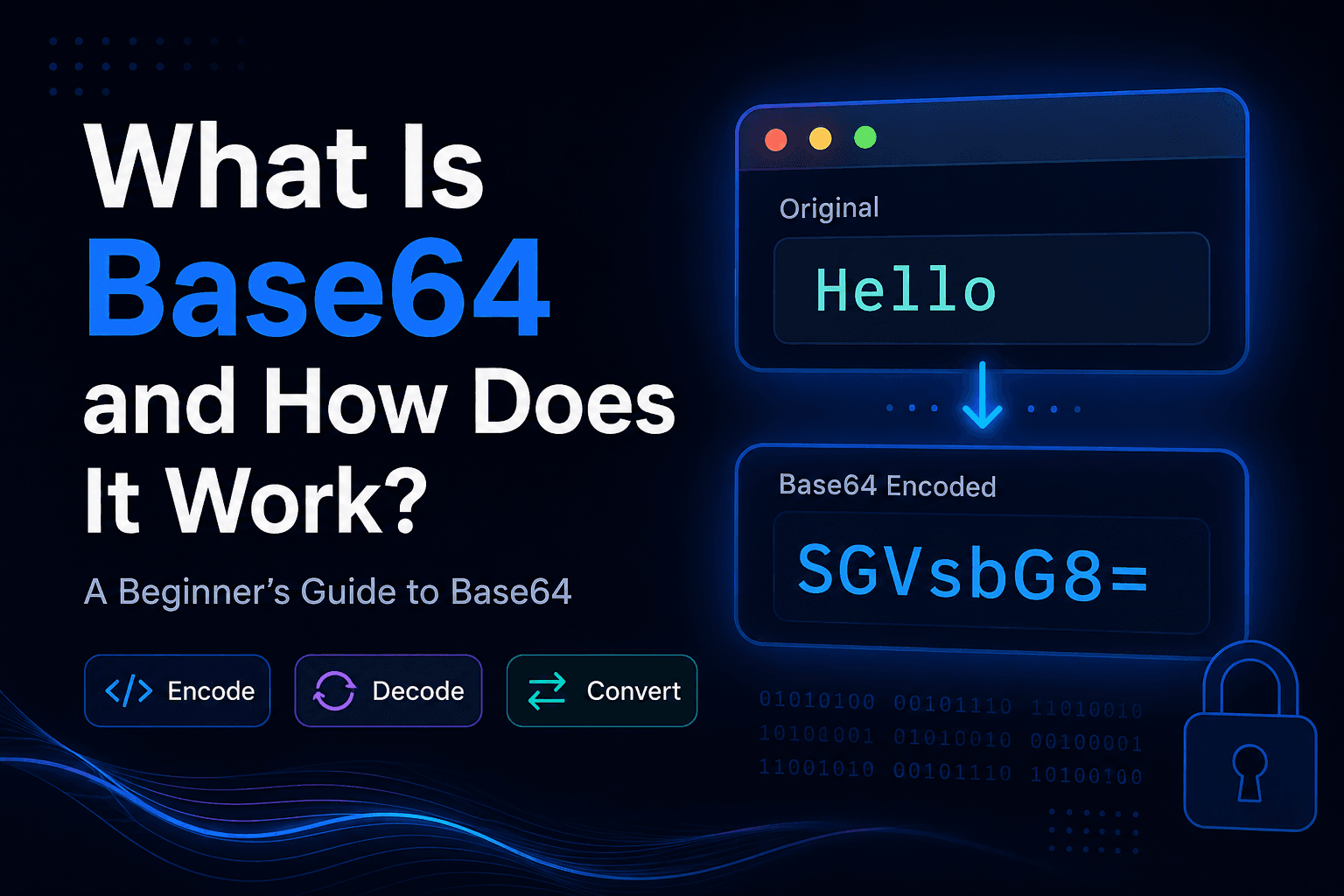
For example:
Original text:
Hello
Base64 encoded:
SGVsbG8=
Why Was Base64 Created?
Many older communication systems were designed to transmit text only.
Binary data such as:
- Images
- PDFs
- Audio files
- Videos
could become corrupted during transmission.
Base64 was created to represent binary information using only readable ASCII characters.
This makes data easier to transfer across different platforms and protocols.
How Does Base64 Work?
Base64 converts binary data into a set of 64 characters.
These characters include:
- A-Z
- a-z
- 0-9
- /
Padding is represented using:
=
When data is encoded, binary values are grouped and converted into these characters.
The result is a text string that can safely travel through systems designed for text.
Base64 Character Set
Base64 uses the following character groups:
Uppercase letters:
A-Z
Lowercase letters:
a-z
Numbers:
0-9
Special characters:
/
Padding:
=
This creates a total of 64 possible characters.
Common Uses of Base64
Base64 appears in many areas of modern development.
Email Attachments
Email systems often use Base64 to encode attachments before sending them.
Data URLs
Images can be embedded directly into HTML or CSS using Base64.
Example:
data:image/png;base64,...
APIs
Some APIs exchange files and images as Base64 strings.
Authentication Tokens
Basic Authentication often relies on Base64 encoding.
File Transfers
Base64 allows binary files to be transferred through text-based systems.
Base64 Encoding Example
Text:
Developer
Encoded:
RGV2ZWxvcGVy
The encoded value can later be decoded back into the original text.
Is Base64 Encryption?
This is a very common misunderstanding.
Base64 is NOT encryption.
Base64 is only encoding.
Anyone can decode a Base64 string easily.
Example:
SGVsbG8=
decodes to:
Hello
If you need security, you should use encryption methods instead.
Advantages of Base64
Easy Data Transfer
Allows binary content to travel through text-only systems.
Widely Supported
Supported by virtually every programming language.
Reliable
Reduces corruption risks during transmission.
Easy to Implement
Encoding and decoding operations are straightforward.
Limitations of Base64
Base64 also has some disadvantages.
Larger File Size
Encoded data becomes approximately 33% larger.
Not Secure
Base64 does not protect sensitive information.
Additional Processing
Encoding and decoding require extra computation.
Base64 in Web Development
Web developers frequently use Base64 when:
- Uploading files
- Sending images through APIs
- Embedding icons
- Working with authentication
- Transferring binary content
Understanding Base64 is useful for both frontend and backend developers.
Why Use an Online Base64 Encoder and Decoder?
An online tool helps developers:
- Encode text instantly
- Decode Base64 strings
- Debug API responses
- Verify encoded content
- Save development time
Instead of writing code every time, you can quickly convert data directly in your browser.
Conclusion
Base64 is a simple but powerful encoding method used throughout modern software development.
It enables binary data to be represented as text, making it easier to transfer files, images, tokens, and other information across different systems.
Although Base64 is not encryption, it remains an essential tool that every developer should understand and know how to use.