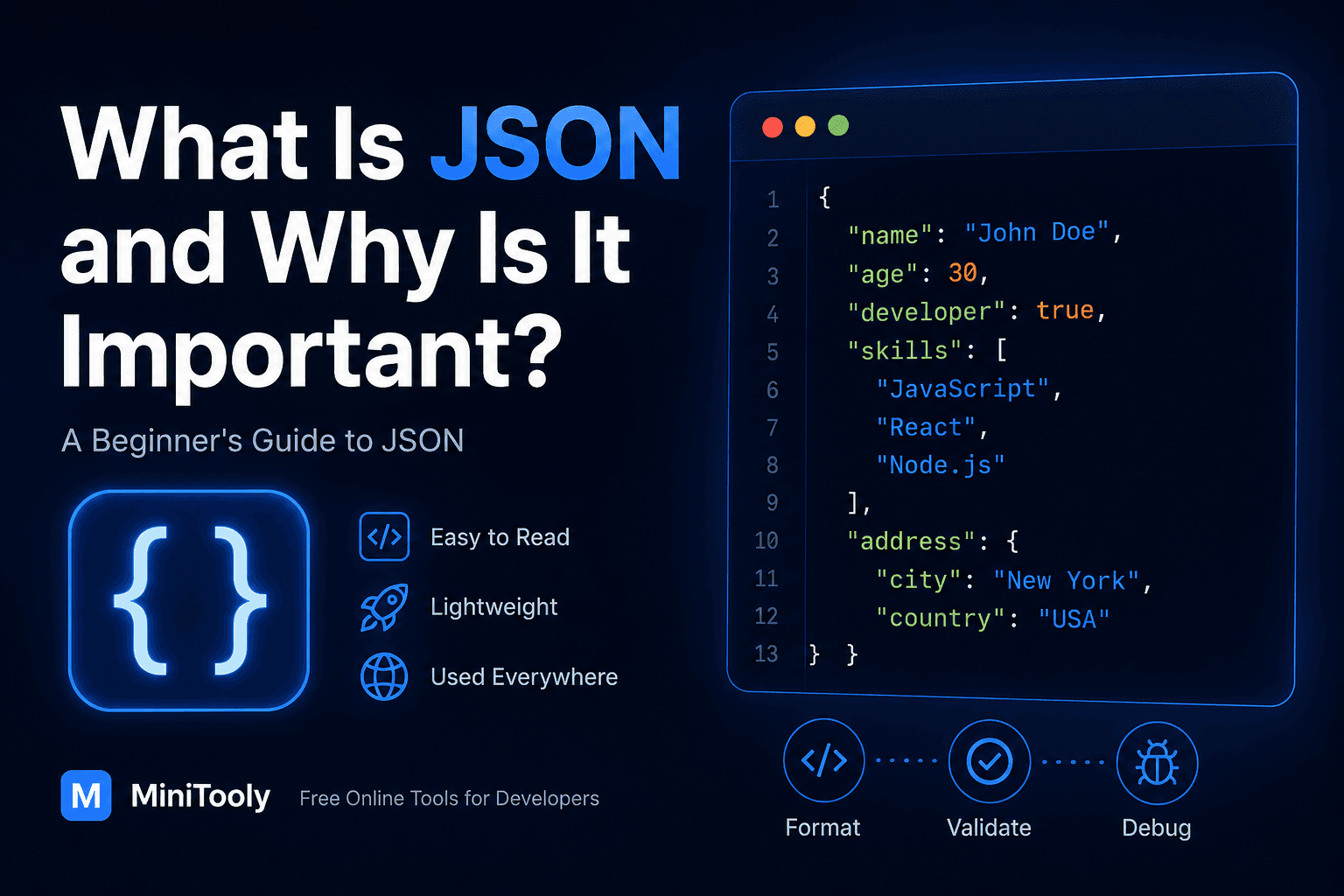
JSON stands for JavaScript Object Notation. It is one of the most widely used data formats in modern software development and serves as the foundation for communication between applications, servers, APIs, and databases.
Although JSON originated from JavaScript, it is now supported by virtually every programming language, including Python, Java, C#, PHP, Go, Ruby, and many others.
If you have ever used a web application, mobile app, or API, chances are that JSON was involved behind the scenes.
What Is JSON?
JSON is a lightweight text-based format used to store and exchange data.
A simple JSON example looks like this:
{ "name": "John", "age": 30, "city": "New York" }
In this example:
- name is a key
- John is a value
- age is a key
- 30 is a value
JSON organizes information using key-value pairs, making it easy for both humans and machines to read and understand.
Why Was JSON Created?
Before JSON became popular, XML was the dominant format for data exchange.
XML worked well but had several disadvantages:
- More verbose syntax
- Larger file sizes
- More difficult to read
- Slower processing
JSON solved these problems by providing a simpler and more compact structure.
As web applications became more complex, JSON quickly became the preferred format for transferring data.
Where Is JSON Used?
JSON is used almost everywhere in modern software development.
Common examples include:
APIs
Most REST APIs return JSON responses.
Example:
{ "id": 1, "username": "developer", "email": "developer@example.com" }
When a frontend application requests data from a server, JSON is usually the format that delivers the information.
Web Applications
Modern frameworks such as:
- React
- Next.js
- Angular
- Vue
use JSON extensively when communicating with backend services.
Mobile Applications
Android and iOS applications commonly exchange JSON data with APIs.
Configuration Files
Many applications use JSON for configuration settings.
Examples include:
- package.json
- tsconfig.json
- eslint.json
Databases
Modern databases such as MongoDB store documents using structures that closely resemble JSON.
Advantages of JSON
JSON became popular because it offers several important benefits.
Easy to Read
The structure is simple and understandable even for beginners.
Lightweight
JSON files are smaller than XML files, reducing bandwidth usage.
Language Independent
Almost every programming language can parse and generate JSON.
Fast Processing
Modern browsers and servers can process JSON very efficiently.
Ideal for APIs
JSON is the standard format used by most modern APIs.
Common JSON Data Types
JSON supports several data types:
String
{ "name": "David" }
Number
{ "age": 25 }
Boolean
{ "active": true }
Array
{ "skills": ["JavaScript", "React", "Node.js"] }
Object
{ "user": { "name": "David", "role": "Developer" } }
Null
{ "phone": null }
Common JSON Errors
Developers frequently encounter JSON syntax errors.
Typical mistakes include:
Missing Quotes
Incorrect:
{ name: "John" }
Correct:
{ "name": "John" }
Trailing Commas
Incorrect:
{ "name": "John", }
Correct:
{ "name": "John" }
Invalid Brackets
Always ensure that brackets and braces are properly closed.
Why Use a JSON Formatter?
As JSON structures become larger, they become difficult to read.
A JSON Formatter helps developers:
- Beautify JSON
- Validate syntax
- Detect errors
- Improve readability
- Debug API responses faster
Instead of manually checking hundreds of lines, a formatter instantly organizes the structure.
JSON in Modern Development
Today, JSON is one of the most important technologies in software development.
Whether you are building:
- Websites
- Mobile apps
- APIs
- Microservices
- Cloud applications
you will almost certainly work with JSON every day.
Understanding how JSON works is a fundamental skill for every developer.
Conclusion
JSON has become the universal language of data exchange in modern software development.
Its simplicity, flexibility, and broad support make it the preferred format for APIs, applications, databases, and configuration files.
Learning JSON is one of the first and most valuable steps for anyone interested in web development, backend systems, mobile applications, or software engineering in general.