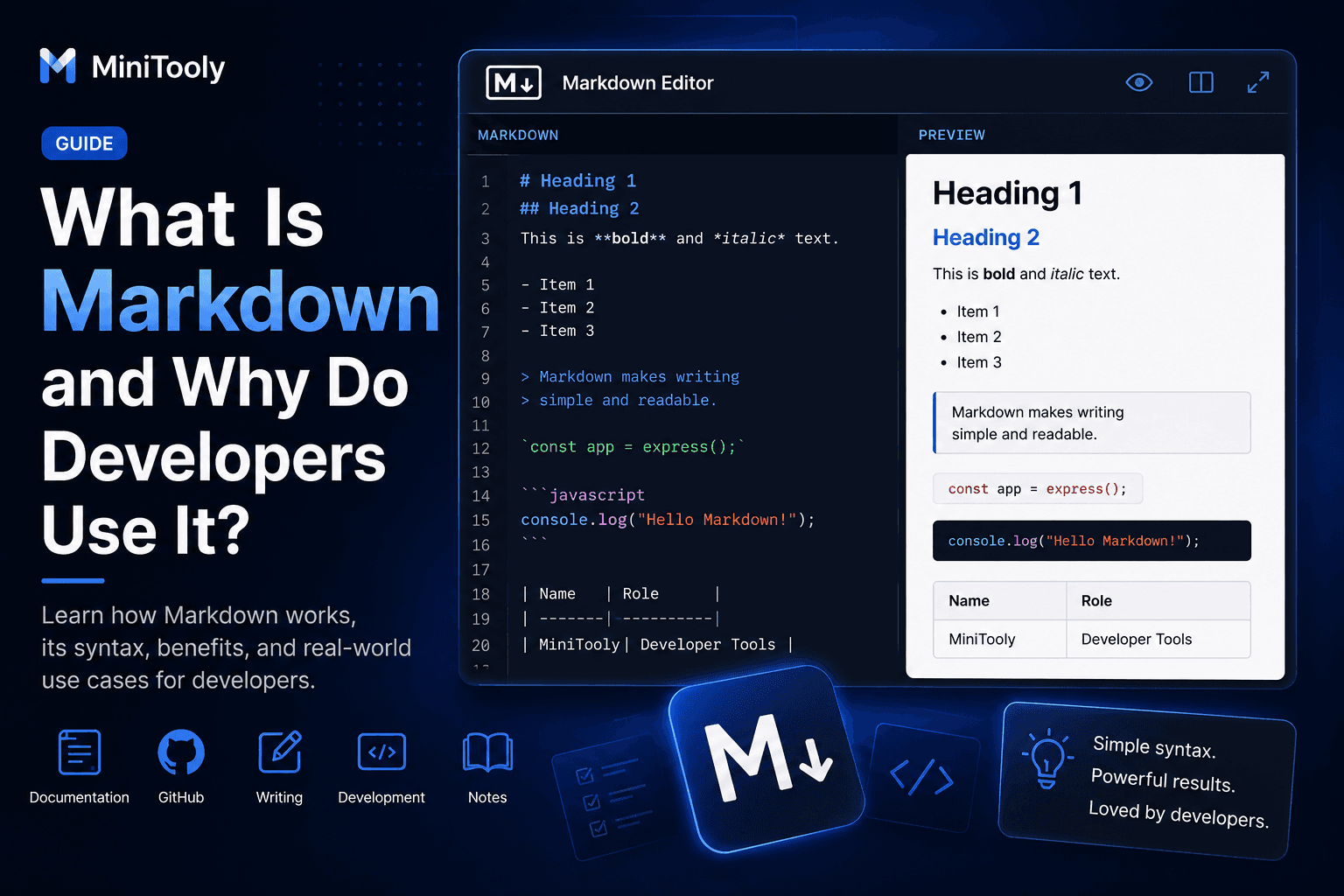
What Is Markdown and Why Do Developers Use It?
If you've ever opened a README.md file on GitHub, written project documentation, or taken notes in apps like Obsidian or Notion, you've already used Markdown. It has become one of the most popular writing formats because it's simple, readable, and easy to learn.
In this guide, you'll learn what Markdown is, how it works, where it's used, and why developers around the world rely on it every day.
What Is Markdown?
Markdown is a lightweight markup language that lets you format text using simple symbols instead of HTML tags.
For example, instead of writing:
<h1>Hello World</h1>
you simply write:
# Hello World
Markdown is designed to be readable even before it's converted into HTML.
Why Was Markdown Created?
Markdown was created by John Gruber in 2004.
Its goal was to make writing documents simple while still allowing them to be converted into clean HTML.
Today, Markdown is supported by thousands of applications and websites.
Where Is Markdown Used?
Markdown is used almost everywhere in software development.
Common examples include:
- GitHub README files
- GitHub Wikis
- Project documentation
- Notion
- Obsidian
- Dev.to
- Discord
- Stack Overflow
- Static site generators
- AI tools like ChatGPT
If you've worked on an open-source project, you've almost certainly used Markdown.
Basic Markdown Syntax
Headings
# Heading 1
## Heading 2
### Heading 3
Bold
**Bold text**
Italic
*Italic text*
Lists
- Apple
- Banana
- Orange
Numbered Lists
1. First
2. Second
3. Third
Links
[MiniTooly](https://minitooly.com)
Images

Inline Code
`const app = express();`
Code Block
console.log("Hello Markdown!");