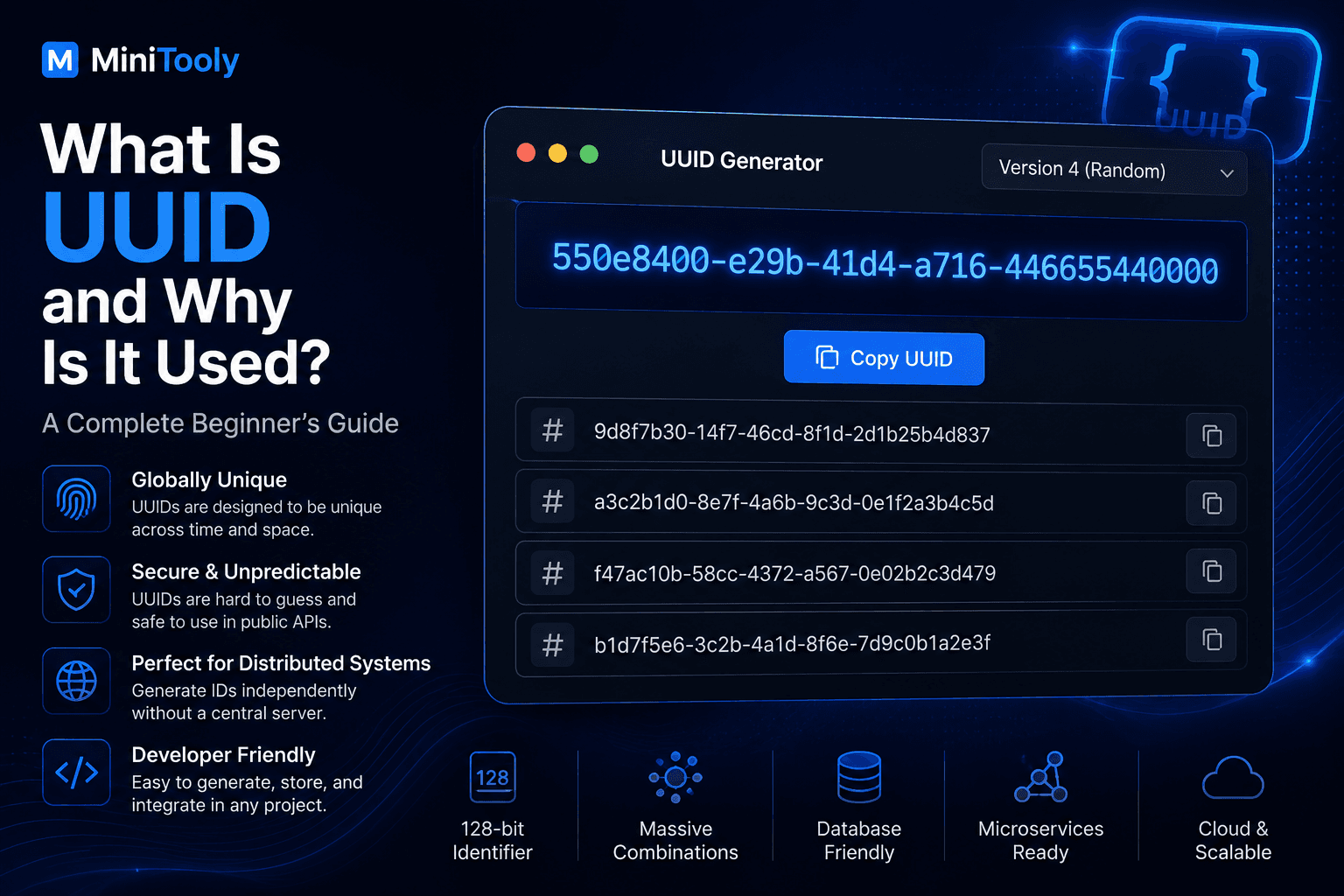
What Is UUID and Why Is It Used?
Every modern application needs a reliable way to identify data. Whether you're building a social media platform, an online store, a banking system, or a distributed microservice architecture, every record must have a unique identifier.
This is where UUID (Universally Unique Identifier) becomes incredibly useful.
Unlike traditional numeric IDs, UUIDs can be generated independently without relying on a central database. This makes them perfect for cloud applications, distributed systems, APIs, and modern software architectures.
In this guide, you'll learn:
- What UUID is
- How UUID works
- Different UUID versions
- UUID vs auto-increment IDs
- Real-world use cases
- Advantages and disadvantages
- Best practices
- Frequently asked questions
By the end of this article, you'll understand why UUID has become the industry standard for generating unique identifiers.
What Is UUID?
UUID stands for Universally Unique Identifier.
It is a standardized 128-bit value designed to uniquely identify information across different computers, databases, applications, and even entire distributed systems.
A typical UUID looks like this:
550e8400-e29b-41d4-a716-446655440000
At first glance, it may seem like a random string of letters and numbers. However, every part of the UUID follows a defined structure specified by international standards.
The identifier contains 32 hexadecimal characters divided into five groups using hyphens.
8-4-4-4-12
This structure allows software to determine information such as the UUID version and variant while ensuring compatibility across different platforms.
One of the biggest advantages of UUIDs is that they can be generated almost anywhere without contacting another server or database.
Because the total number of possible UUIDs is approximately 340 undecillion, the probability of generating two identical UUIDs is so incredibly small that collisions are considered practically impossible when using a proper implementation.
Why Do Developers Use UUID?
For many years, databases primarily relied on sequential numeric IDs.
For example:
1
2
3
4
5
Although this approach is simple, it introduces several limitations as applications become larger.
Sequential IDs require a central authority to generate new values. They also expose information about the total number of records stored in a database, making them predictable.
UUIDs solve these problems.
Developers use UUIDs because they:
- Generate globally unique identifiers
- Work across multiple databases and servers
- Prevent ID collisions
- Improve security by making identifiers difficult to guess
- Support distributed systems and microservices
- Simplify data synchronization
- Allow offline identifier generation
Today, UUIDs are widely used by companies such as Google, Microsoft, Amazon, GitHub, Stripe, and many cloud-based SaaS platforms.
Whenever data must remain unique across multiple systems, UUID is often the preferred solution.